
In my earlier article, Digital Value Creation: Turning Web Effectiveness into Shareholder Growth, I introduced a simple but powerful idea:
When websites operate as integrated systems of value creation rather than disconnected channels, they become capital assets in their own right.
That framework outlined five dimensions of digital value creation — the bridge between web performance and enterprise performance:
- Revenue Growth – expanding market reach, discoverability, and conversion efficiency.
- Cost Efficiency – lowering acquisition, service, and operational costs through automation and integration.
- Capital Efficiency – reducing redundant investments by reusing systems, content, and infrastructure globally.
- Risk & Resilience – protecting future value through compliance, uptime, security, and accessibility.
- Innovation & Optionality – enabling future growth through structured data, modular systems, and scalability.
Each of these dimensions directly connects to the metrics boards use to evaluate CEO performance — from operating margins to return on invested capital (ROIC).
When digital works, it compounds shareholder value.
When it doesn’t, it silently leaks it away.
The Hidden Economics of Digital Leakage
In private equity and enterprise finance, Economic Profit (EP) — the value created above the cost of capital — is the ultimate measure of success.
Every inefficiency in your digital ecosystem subtracts from that number.
Think of your website and digital systems as an operating interface for the business.
Every page, system, and workflow either compounds enterprise value — or quietly erodes it.
Let’s look at the six most common detractors of web effectiveness that block this value creation cascade — and what to do about each.
1. Fragmentation: The Silent Revenue Killer
“We don’t have a web problem. We have 17 versions of it.”
The first detractor is fragmentation — the proliferation of disconnected websites, microsites, and market-specific platforms that splinter brand visibility and search equity.
It usually starts innocently:
A new market launches a regional CMS.
A product team spins up a microsite.
A division maintains its “legacy platform” for just one more year.
Multiply that across regions and brands, and suddenly your company’s online footprint resembles an unmapped city — full of duplicate streets, dead ends, and missed opportunities.
Why it matters:
Fragmentation kills discoverability. It splits backlinks, dilutes authority, and confuses both customers and search engines.
In a global audit, we found U.S. pages outranking local versions in 14 markets, resulting in millions in cross-market cannibalization and customer frustration.
How to fix it:
- Consolidate to a language- and brand-based architecture, not market silos.
- Deploy a unified CMS that enforces global standards while allowing local flexibility.
- Use hreflang governance and cross-market canonical logic to direct the right users to the right version.
Impact:
Restores discoverability, strengthens conversion, and aligns with the Revenue Growth and Capital Efficiency dimensions of digital value.
2. Redundancy: The Hidden Cost Drain
“We don’t need a bigger budget — we need fewer budgets doing the same thing.”
Redundancy happens when teams, agencies, or markets rebuild the same tool, content, or workflow because they can’t reuse what already exists.
It’s a hallmark of low digital maturity — when systems, not strategy, dictate execution.
Why it matters:
Duplicated content inflates maintenance costs.
Duplicated martech stacks inflate SG&A.
Duplicated governance inflates risk.
It’s not just wasteful — it’s capital-inefficient. Every dollar spent re-creating a solved problem is a dollar not reinvested in innovation.
How to fix it:
- Establish a Digital Center of Excellence to centralize shared assets and enforce reuse.
- Audit global martech licenses and consolidate wherever functionality overlaps.
- Introduce modular content frameworks — one asset, multiple uses.
Impact:
Cuts operating cost, improves Capital Efficiency and Cost Efficiency, and builds scalable infrastructure for growth.
3. Friction: The Experience Tax You Never See
“Our users aren’t dropping off — they’re giving up.”
While fragmentation and redundancy are visible, friction is invisible — the tiny usability, speed, or process barriers that silently reduce conversion and satisfaction.
Friction shows up in micro-moments:
A slow page load.
A broken translation.
A redundant login.
A form field that doesn’t autofill on mobile.
Individually small. Collectively massive.
Why it matters:
Friction is an experience tax — paid in lost revenue, increased service costs, and reduced lifetime value.
It erodes Revenue Growth and Cost Efficiency simultaneously.
How to fix it:
- Make Core Web Vitals and UX friction scores part of quarterly performance reporting.
- Use session replay and analytics tools to identify drop-off points.
- Tie every UX improvement to a financial outcome (e.g., 0.5s faster load = +2% conversion).
Impact:
Turns UX optimization into measurable ROI and demonstrates that experience improvements are financially material — not aesthetic.
4. Misalignment: The Organizational Drag Coefficient
“Our systems don’t talk. Neither do our teams.”
Even the best tools fail when incentives, ownership, and accountability are misaligned.
Misalignment occurs when digital initiatives operate in silos — marketing pursues traffic, IT pursues uptime, legal pursues compliance — with no shared definition of success.
Why it matters:
Misalignment compounds inefficiency across every dimension of value creation.
It creates capital drag — the corporate equivalent of friction — where investments don’t translate into results because teams are optimized for local success, not enterprise performance.
How to fix it:
- Define shared KPIs across marketing, IT, and finance that ladder up to enterprise metrics.
- Use a Web Effectiveness Charter to define purpose, scope, and governance.
- Tie digital initiatives to capital allocation frameworks and ROIC targets.
Impact:
Reduces internal resistance, improves accountability, and directly increases Capital Efficiency and Risk Resilience.
5. Vulnerability: The Risk Premium Nobody Sees Coming
“You can’t compound value if you’re constantly paying to repair it.”
Security lapses, compliance violations, and accessibility failures all fall under digital risk leakage — one of the most underestimated detractors of enterprise value.
Every outage or breach doesn’t just interrupt service — it raises your cost of capital.
Investors and rating agencies increasingly view digital resilience as a proxy for leadership quality and operational maturity.
Why it matters:
A security breach or accessibility fine may hit once, but the risk premium it creates lingers — eroding brand trust, driving up insurance costs, and lowering market valuation.
How to fix it:
- Integrate resilience and compliance KPIs into Web Effectiveness reporting.
- Implement SLA-based governance for uptime, accessibility, and data protection.
- Treat cybersecurity investments as value protection, not IT overhead.
Impact:
Reduces volatility, preserves trust, and safeguards the Risk & Resilience dimension of digital value.
6. Inflexibility: The Innovation Tax
“We can’t test new ideas because our systems were built for 2016.”
The final detractor is inflexibility — legacy systems and rigid governance models that slow experimentation and limit future growth.
When your infrastructure can’t evolve, you can’t adapt to new AI integrations, new content formats, or new buyer journeys.
Inflexibility is not just a technical issue; it’s a strategic liability.
Why it matters:
A slow digital environment increases time-to-market, inflates opportunity cost, and reduces enterprise optionality — the ability to seize emerging opportunities without major reinvestment.
How to fix it:
- Move toward modular, API-driven architectures that allow feature swaps without full rebuilds.
- Prioritize structured data readiness to enable AI retrieval and automation.
- Build sandbox environments for experimentation and testing.
Impact:
Reclaims agility, accelerates innovation, and activates the Innovation & Optionality dimension of digital value.
The Compound Effect: Digital Leverage as Operating Leverage
Private equity has understood this for decades.
They view digital maturity not as an expense, but as operating leverage — the multiplier that increases yield from every other investment.
- A global brand with a unified CMS and cross-market governance deploys new products 10× faster — improving ROIC.
- A B2B manufacturer with structured product data for AI retrieval shortens sales cycles — boosting cash flow.
- A service enterprise with self-service workflows lowers cost-to-serve — expanding margins.
Each of these contributes directly to Economic Profit — value created above the cost of capital — the same metric boards use to determine CEO compensation.
In other words:
Digital maturity is financial maturity.
And Web Effectiveness is the system that converts one into the other.
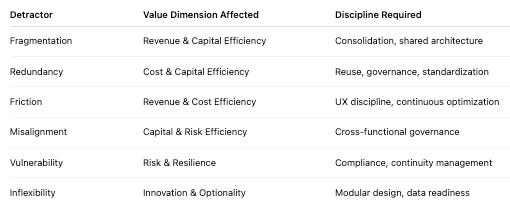
From Detractors to Disciplines
Each detractor represents a failure mode in one or more of the five value dimensions.
Each can be reversed by introducing discipline — the kind that MBAs and capital managers apply to physical assets every day.
The Realization: Web Effectiveness Is a Fiduciary Domain
Every inefficiency in your digital ecosystem quietly subtracts from the CEO’s scorecard.
Revenue leakage lowers growth.
Redundancy inflates cost.
Inflexibility limits innovation.
Risk increases cost of capital.
These aren’t web metrics — they’re enterprise metrics.
That’s why the CEO must own Web Effectiveness as a fiduciary function.
The website isn’t a communications channel anymore — it’s the operating interface of the enterprise.
It’s where efficiency, reputation, and scalability are earned or lost.
What Comes Next: The Case for an MBA Mindset in Web Effectiveness
In the follow-on article in this series, Why an MBA Should Manage Your Web Effectiveness Team, we’ll explore what happens when you apply financial governance to digital operations.
We’ll look at how capital allocation, payback modeling, and ROIC tracking can transform web performance from a marketing cost to a balance-sheet asset — and how this shift forces teams to align creativity, technology, and accountability under one system of value.
Because the truth is simple:
The web doesn’t need more marketers or developers. It needs capital managers.