
Google has an extraordinary ability to reshape the architecture of the internet without ever issuing a single corporate mandate. It doesn’t force compliance; it simply builds a dashboard.
For over two decades, every major evolution of the web has followed the exact same script: Google introduces a metric, the industry debates the technical details, and then millions of websites quietly rewrite their roadmaps. We saw it when PageSpeed turned milliseconds into a boardroom KPI. We saw it when Mobile-Friendly testing forced global responsive design. We saw it again with Core Web Vitals.
The metrics themselves always felt urgent, but their true power lay in their ability to subtly manipulate human behavior at a global scale. In every case, the conversation centered on the metric. What happened next was far more interesting. The metrics themselves mattered, but their larger impact came from something else entirely. They changed behavior.
Millions of websites have changed. Development priorities shifted. Platforms added new capabilities. Agencies built new service offerings. Entire categories of software emerged.
Today, that exact same playbook is unfolding with the quiet release of Google’s new Agentic Scorecard in Chrome DevTools. While the industry is currently bogged down in the weeds debating the immediate utility of files like llms.txt and agents.md, they are missing the far more profound reality: Google isn’t just building a tool to measure the AI-driven web. It is using its favorite psychological loophole to create it.
The Agentic Scorecard may be less important as a measurement tool than as the latest example of a pattern Google has been using for more than two decades: influencing the future of the web by deciding what gets measured.
📡 The Signal: Measuring The Future
Google recently introduced an Agentic Scorecard in Chrome DevTools, enabling developers to assess how prepared their websites are for AI agents and machine-driven interactions.
Predictably, the SEO community immediately began dissecting the individual factors. Does llms.txt matter? Will markdown become important? Are these ranking signals? Should every website implement these recommendations immediately?
Those are reasonable questions. They may also be the wrong questions.
When I first saw the scorecard, I was reminded of something Google has been doing for more than two decades. Google rarely changes the web through mandates. Instead, it changes the web through measurement.
Over time, those measurements become reports. The reports become dashboards. The dashboards become KPIs. Eventually, development teams, agencies, consultants, platforms, and executive sponsors begin working toward the same visible goals. The result is often a web that moves in a direction Google believes will improve the experience for users, search engines, advertisers, or increasingly, AI systems.
We have seen this pattern repeatedly.
- PageSpeed encouraged faster websites.
- Mobile-Friendly Testing accelerated responsive design.
- HTTPS reports helped normalize encrypted websites.
- Structured data initiatives increased machine-readable content.
- Core Web Vitals pushed performance engineering into executive dashboards.
Each began as a measurement. Each ultimately influenced how websites were built.
Each began as a measurement. Each ultimately influenced how websites were built.
The Agentic Scorecard appears to be the latest chapter in that story, with a fascinating modern twist. Unlike past initiatives in which Google created the underlying standards, protocols like llms.txt and agents.md originated organically within the independent AI community. Google didn’t invent them; it simply began measuring them. By putting them in a DevTools scorecard, Google is effectively co-opting these grassroots specifications and absorbing them into its compliance pipeline.
🔄 The Behavior Change Loop
What makes the Agentic Scorecard interesting is not any individual recommendation. It is the role the scorecard plays within a much larger pattern that Google has refined over decades.
Rather than mandating how websites should evolve, Google has repeatedly influenced the direction of the web by deciding what gets measured. Once a behavior becomes visible through a tool, report, dashboard, or scorecard, it attracts attention. Attention leads to discussion. Discussion leads to implementation. Over time, the behavior spreads across platforms, organizations, and ultimately the web itself.
The process has become so predictable that it almost resembles a playbook.
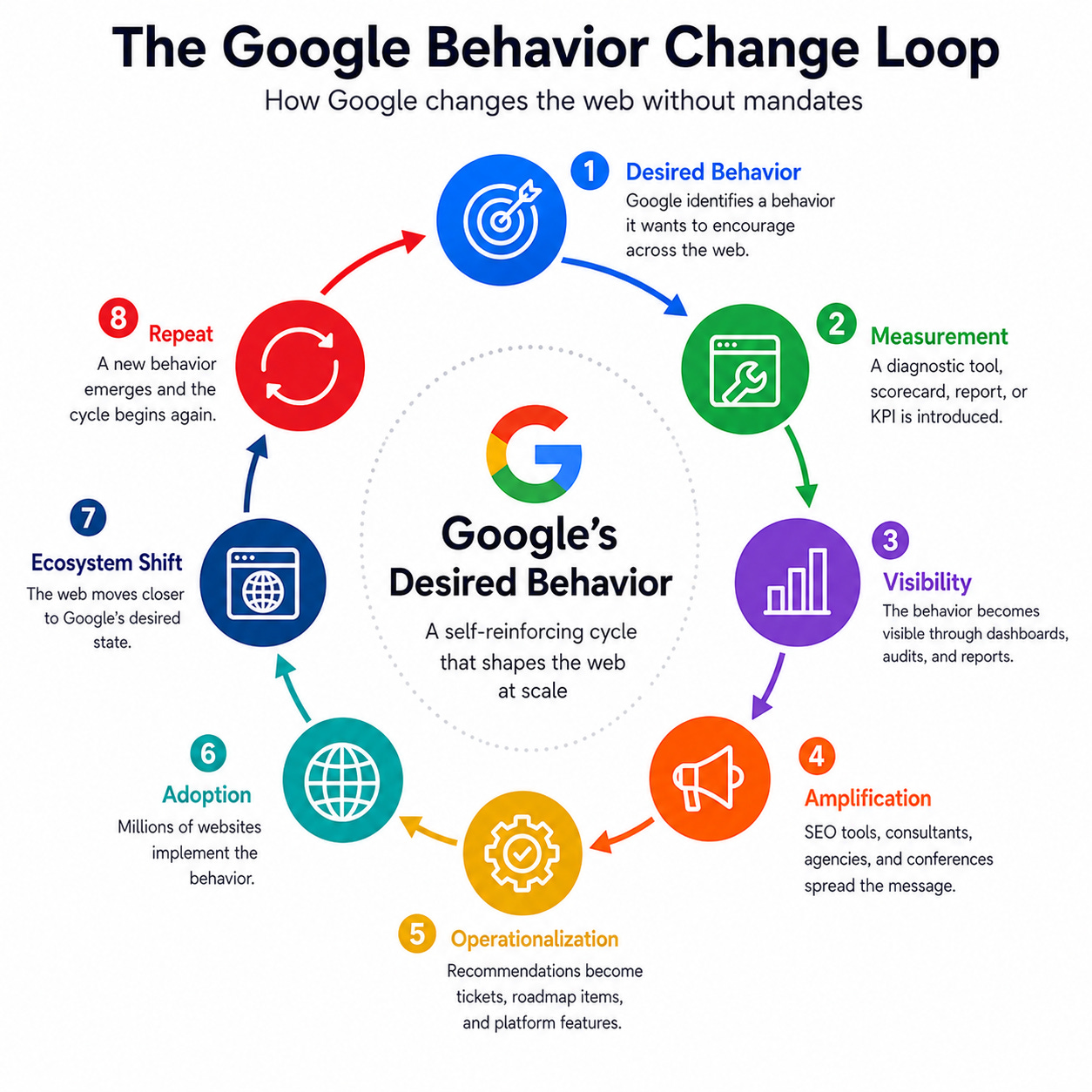
Viewed through this lens, the Agentic Scorecard may be less about evaluating today’s AI ecosystem and more about accelerating the behaviors required for tomorrow’s.
The individual recommendations will likely evolve. Some may become important. Others may disappear entirely. History suggests that is not the most important part of the story.
What matters is that the behaviors are now measurable.
Once that happens, they begin appearing in audits, scorecards, executive dashboards, platform roadmaps, consultant recommendations, and development backlogs. The result is that millions of organizations start moving in the same direction long before the underlying standards have fully matured.
That may be the most powerful aspect of the Agentic Scorecard. It does not merely measure readiness for an agentic future. It helps create it.
⚙️ The Friction: Mistaking The Tool For The Transformation
The discussion surrounding the Agentic Scorecard has quickly settled into familiar territory. Conversations focus on whether llms.txt matters, whether agents.md will become a standard, whether markdown provides advantages, and whether any of these elements influence AI visibility today.
Those questions are understandable, but they also risk obscuring the more important signal.
The history of search is filled with examples in which the industry became fixated on implementation while missing the broader transformation it represented. XML sitemaps were never really about XML. Structured data was never really about JSON-LD. Core Web Vitals were never fundamentally about achieving a particular score. Each was a visible manifestation of a larger shift in how websites would be evaluated, understood, and experienced.
The current discussion around agentic signals feels remarkably similar.
Google representatives have openly stated that llms.txt is not currently used within the Search pipeline and provides little direct value today. Independent testing has yet to demonstrate meaningful improvements in AI visibility or citations. Under normal circumstances, such limited evidence would slow adoption.
Instead, the opposite appears to be happening.
Platforms are incorporating support. SEO tools are adding checks. Consultants are recommending implementation. Development teams are creating tickets. Organizations that have never previously discussed machine-readable content are suddenly evaluating agent-facing specifications and AI-readiness assessments.
Shopify offers a particularly telling example. The company rapidly deployed support for llms.txt across millions of stores, normalizing the practice almost overnight. Soon afterward, many implementations began shifting toward agents.md, illustrating how quickly the standards themselves are evolving.
This rapid adoption highlights the true power of the playbook. When a community-driven experiment is canonized by a tech giant’s diagnostic tool, the industry stops treating it as an optional idea and starts treating it as an operational requirement.
Whether either approach ultimately proves valuable is almost beside the point. What matters is how quickly visibility becomes adoption.
The moment a capability appears within a scorecard, dashboard, audit, or readiness assessment, it enters a completely different phase of organizational life. What began as an experimental specification becomes a recommendation. The recommendation becomes a ticket. The ticket becomes a roadmap item. The roadmap item becomes a platform feature. Before long, millions of websites have implemented capabilities that few organizations would have prioritized on their own.
This is why the individual protocols matter less than many people believe.
Whether information is ultimately exposed through llms.txt, agents.md, APIs, structured data, markdown, or some future standard is a technical detail that will likely continue to evolve. The more enduring trend is that machines increasingly benefit from information that is easier to extract, interpret, connect, and act upon.
The industry may be debating files and formats. The larger transformation is the gradual evolution of the web toward machine-readable and machine-operable information.
That shift was already underway long before llms.txt appeared. The Agentic Scorecard simply gives the industry a mechanism to measure it, discuss it, and most importantly, accelerate it.
💥 The Realization: What Gets Measured Shapes Behavior
The most interesting aspect of the Agentic Scorecard may have very little to do with AI agents.
It may instead be another reminder of how organizations change.
For more than two decades, Google has demonstrated an extraordinary ability to influence the evolution of the web without directly controlling it. Rather than issuing mandates, it creates measurements. Those measurements become reports. The reports become dashboards. The dashboards become KPIs. Before long, development teams, agencies, consultants, platforms, and executive sponsors are all working toward the same set of visible goals.
The outcome is not simply measurement. The outcome is behavior change.
PageSpeed did not transform the web because developers suddenly became passionate about milliseconds. Mobile-Friendly Testing did not accelerate the adoption of responsive design because organizations independently concluded that it was strategically important. Core Web Vitals did not become executive talking points because business leaders developed a deep interest in rendering performance.
These initiatives succeeded because they became measurable.
Once a metric becomes visible, it becomes actionable. Once it becomes actionable, it enters planning cycles, budgets, audits, roadmaps, vendor evaluations, and performance reviews. At that point, the metric is no longer measuring behavior. It is helping create it.
The Agentic Scorecard appears to be following the same path.
That observation matters because it extends far beyond SEO.
Organizations rarely optimize for strategy. They optimize for what is measured.
Metrics are incredibly useful because they help organizations focus effort and resources. Problems arise when the metric becomes the objective rather than a proxy for it.
The companies that gained the most value from PageSpeed were not necessarily those that achieved the highest scores. They were the ones who understood the relationship between performance and customer experience. The organizations that benefited most from structured data were not always those pursuing rich snippets. They were the ones who recognized that machine-readable information would become increasingly important as search engines evolved.
The same lesson applies here.
The real signal is not llms.txt. It is not agents.md. It is not markdown. It is not even the Agentic Scorecard itself.
The signal is that information is increasingly being consumed, interpreted, recommended, and acted upon by machines. The scorecard simply provides a mechanism for accelerating behaviors that support that future.
Organizations that focus exclusively on passing the test may gain a short-term sense of progress. Organizations that understand why the test exists are more likely to build systems, content, and processes that remain valuable long after today’s scorecards have been replaced by tomorrow’s.
And just like that, agentic performance factors begin to appear in development roadmaps, platform features, and executive discussions long before AI agents reach broad consumer adoption and long before many of the underlying standards have fully matured.
The score becomes the marketing.
The recommendation becomes the requirement.
The implementation becomes the standard.
The web shifts.
Perhaps the Agentic Scorecard is not really a tool for measuring the future.
Perhaps it is a tool for creating it.
🏢 Boardroom Moment: Be Careful What You Measure
One of the most important lessons in business is that metrics rarely remain passive measurements. Over time, they become instructions.
The moment a metric appears on a dashboard, it begins influencing decisions. Teams allocate resources against it. Managers discuss it in status meetings. Budgets are justified through it. Vendors build products around it. Performance reviews incorporate it. Entire initiatives emerge to improve it.
Eventually, people stop asking why the metric exists and start asking how to improve the score.
That subtle shift is where many organizations get into trouble.
The Agentic Scorecard provides a useful reminder of how quickly this process can unfold. A new measurement appears. Visibility increases. Discussions follow. Recommendations become requirements. Before long, organizations invest time and resources in improving a score, even when the long-term business value remains uncertain.
The same dynamic plays out inside companies every day.
- Customer service teams optimize response times while customer satisfaction declines.
- Marketing teams optimize lead volume while sales quality deteriorates.
- Product teams optimize feature delivery while adoption stalls.
- Operations teams optimize efficiency while customer experience suffers.
In each case, the metric began as a proxy for an outcome. Over time, the proxy became the objective.
The organizations that navigate these transitions most successfully are not the ones that ignore metrics. They are the ones that continually reconnect the metric to the outcome it was intended to support.
That requires periodically stepping back and asking a deceptively simple question:
What behavior is this measurement encouraging?
The answer often reveals whether a metric is helping the organization move toward its goals or simply creating activity that appears to be progress.
The lesson from the Agentic Scorecard is not really about AI, SEO, or even Google.
It is a reminder that what gets measured gets managed, but what gets managed is not always what matters most.
The most effective leaders understand the difference.
Originally posted in my Substack Signal and Friction