
Emotifacts are the unit of content where feeling and fact are inseparable, why the agentic web makes it essential, and how a copywriter and a taxonomist finally have to build it together
We coined the word emotifact in passing, and it has been carrying more weight than a passing definition can hold. This is its proper home: what an emotifact is and is not, why it was always doing the work even when no one named it, why the present moment forces it into the open, and how the two disciplines that have spent thirty years avoiding each other actually produce one. It is the foundational idea beneath everything else we have written about the agentic web.
Two people who have never had to share a sentence
A copywriter and a taxonomist have spent their careers not needing to speak to each other.
The copywriter owns the feeling. The headline that makes you want the thing, the line that turns a jacket into a small promise about the kind of winter you intend to have. To the copywriter, structure is where soul goes to die: the moment you break a sentence into fields and attributes, you have killed the thing that made someone reach for their wallet.
The taxonomist owns the structure. The categories, the attributes, the clean machine-readable model of what a thing actually is and how it relates to everything else. To the taxonomist, feeling is noise, the soft and unverifiable haze you strip away before the data is any use to a system.
They have worked in the same companies, often on the same products, and almost never on the same sentence. And both of them are right, which is exactly the problem. The copywriter is right that emotion is what closes the sale. The taxonomist is right that structure is what a machine can read. For thirty years the web let them stay in separate rooms, because the only reader that mattered was a human looking at a rendered page, and a human could feel the photograph the copywriter chose without the taxonomist ever having to model the feeling.
The agentic web ends the separation, because it introduces a reader who needs exactly what only the two of them, together, can produce. That shared object has a name. It is an emotifact.
What an emotifact is, and what it is not
An emotifact is a unit of content in which the persuasive, emotional signal and the verifiable fact are fused into a single expression, such that removing either one destroys the decision value.
The definition lives or dies on that last clause, so hold onto it, because a concept that includes everything explains nothing. Consider three lines about the same jacket.
“Insulated to minus ten, 240 grams.” That is a fact. It is true, it is machine-readable, and it is inert. It tells you what the jacket is and nothing about whether it is for you.
“Command the winter.” That is a feeling. It is evocative and entirely empty. There is no fact in it to verify, nothing an agent could match against a need, nothing that survives a skeptical question.
“Warm enough for a Reykjavik winter, packs down to nothing.” That is an emotifact. The warmth and the packability are facts. The Reykjavik winter and the picture of yourself unburdened by your own coat are the feeling. And they are fused: strip the emotion and you have a spec sheet that does not tell a traveler it is for them; strip the fact and you have a mood with nothing underneath it. Remove either half and the line stops helping anyone decide. That is the test. Not the presence of emotion, not the presence of fact, but the fusion that makes both necessary at once.
The test matters because it draws a real boundary. Most marketing copy is pure feeling with the facts in a separate table somewhere. Most structured data is pure fact with the feeling left to the photography. The emotifact is the rarer thing that does both jobs in one expression, and it is rare precisely because the two people who could make it have never had to make it together.
The hardest case: what does it taste like
The jacket is a comfortable example, because warmth is already half a measurement. The example that actually settles the argument comes from a category where everyone swears facts are impossible.
Working with Absolut Vodka, one of the most common questions buyers asked about every product, especially those that are not flavor specific, was the simplest and the hardest: ” What does this vodka taste like? For Absolut Citron, the content team answered it on the site, in the brand’s own voice, rather than leaving a machine to guess. They published two answers to the same question, and the pair is the most complete demonstration of an emotifact we have seen in the wild.
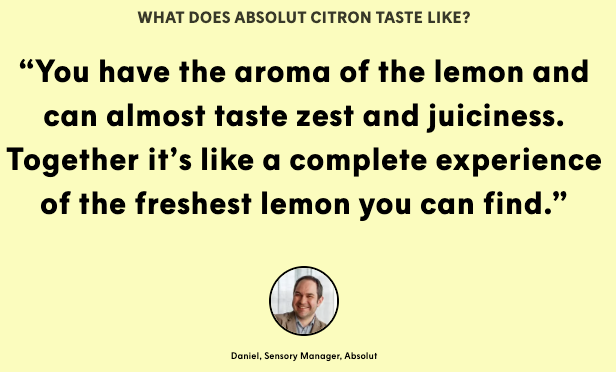
The first came from Daniel, a Sensory Manager at Absolut: “You have the aroma of the lemon and can almost taste zest and juiciness. Together it’s like a complete experience of the freshest lemon you can find.” The aroma, the zest, the juiciness are facts, sensory attributes a system can match against “something citrus-forward and fresh.” The freshest lemon you can find, a complete experience, is the feeling. Strip the experience, and you have a flavor list that makes no one thirsty; strip the sensory facts, and you have an empty boast. It passes the test cleanly.
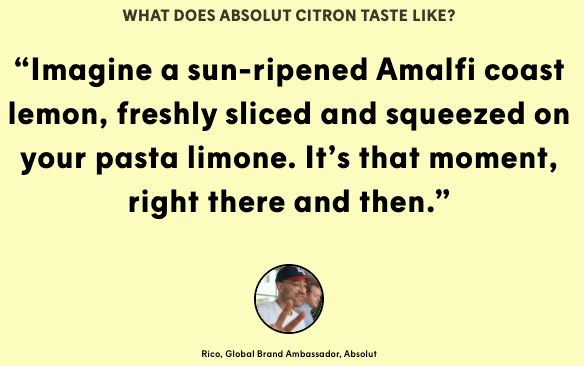
The second came from Rico, a Global Brand Ambassador: “Imagine a sun-ripened Amalfi coast lemon, freshly sliced and squeezed on your pasta limone. It’s that moment, right there and then.” Rico barely lists an attribute, and it is still an emotifact, because the facts are smuggled inside the scene. Sun-ripened and Amalfi signal sweetness and brightness. Freshly squeezed signals sharp and clean. Pasta limone places it as bright and food-friendly rather than candied. The feeling is the carrier, and the facts ride inside it.
Two things about that pair are worth slowing down on, because they teach more than a single example could.
First, emotifacts have range. Daniel’s sits at the analytic end, where the fact leads and the feeling frames it. Rico’s sits at the experiential end, where feeling leads and fact dissolves into place and moment. Both pass the test, and they answer different questions: Daniel’s satisfies “is it citrus-forward and fresh,” Rico’s satisfies “will this feel like a bright Mediterranean afternoon.” Those are two different ways a person asks the taste question, which means two different verbs an agent might pose, and by publishing both, the brand covered both. That is what authoring emotifacts looks like as a practice. Not one perfect line, but a deliberate set, each tuned to a different register of the same demand.
Second, look at who said each one. The sensory claim is attributed to the Sensory Manager, technical credibility for a technical-leaning emotifact. The experiential claim is attributed to the Brand Ambassador, whose authority lies precisely in evoking the moment. The brand attached the right kind of authority to the right kind of answer. That is provenance, and it is the trust signal the machine layer increasingly wants bound to a claim: this is credible because a fitting human said it. They did not just write two emotifacts. They sourced each to the voice whose expertise makes it believable.
And now look again at those two job titles, because this is the part that stops the whole argument from being a metaphor. A Sensory Manager is the taxonomist in the wild: a person whose entire job is to decompose a feeling into verifiable attributes, the aroma, the zest, the juiciness, the structured truth of a taste. A Brand Ambassador is the copywriter in the wild: a person whose job is to evoke the moment, the Amalfi coast, the pasta limone, the feeling that closes the sale. The two disciplines this article is about are not a rhetorical device. Absolut employs both of them by name and points them at the same question. The decomposer and the scene-setter are real roles, and a vodka company is paying for each.
Which raises the line worth sitting with: how many companies have a Sensory Manager? Almost none, and that is exactly why almost none can answer “what does it taste like” with structured sensory truth. Absolut can, because they pay someone to know it. The capability is rare because staffing is scarce, and the agentic web is about to make that gap visible: brands without a sensory-manager equivalent will have nothing structured to say when the taste question is asked of a machine. The role’s rarity is not a detail. It is the reason good emotifacts are scarce.
This is the example that wins the argument, because taste is the attribute the creative tribe was most certain could never be structured. If you can answer what a vodka tastes like in a way a human craves and a machine can match, the claim that emotion resists structure collapses at its hardest case. And notice the brand did this by listening to demand, by answering the question buyers actually kept asking, which is exactly where emotifacts should come from in the first place.
Why it was always doing the work
The temptation is to treat the emotifact as a new invention, a clever thing we devise so machines can feel. That gets the history backwards.
Human beings have never made decisions on facts alone. The fact tells you the jacket is warm; the feeling tells you it is warm for the life you are imagining. Emotion has always carried decision weight in every purchase anyone has ever made. We simply never had to make that weight explicit, because the rendered page carried it for us. The hero photograph did the feeling. The model on the trail, in the soft light, captured the feeling. The copywriter’s headline evoked a feeling, and a human absorbed all of it in a glance, fused it with the spec in the table below, and decided. The fusion happened, but it happened in the reader’s head, assembled from a page designed to make it happen there.
The agent cannot stand in front of the photograph and feel it. It does not absorb the soft light. It reads what is declared, and if the only thing declared is “insulated to minus ten,” then the entire emotional half of the decision, the half that was always there, simply vanishes from the agent’s view. The persuasion that a human page handled implicitly has to become explicit, or it is lost.
So the emotifact is not a trick invented for machines. It is the surfacing of something that was always doing the work, now forced into the open because the new reader cannot infer it from a hero image. We are not adding emotion to data. We are writing down the emotion that was always there and was always deciding, because for the first time, the reader cannot supply it themselves.
The two disciplines, and why neither could do this alone
Return to the copywriter and the taxonomist, because the reason emotifacts are rare is the reason those two have never shared a sentence.
The creative tradition has always known that emotion sells, and has always treated structure as the enemy of the soul. Ask a brand team to render their best line as a tagged, attributed field, and they will tell you, correctly, that you are about to sand the feeling off it. They have defended the feeling by keeping it out of the structure, in the headline, the photograph, the layout, the places a machine does not read.
The structural tradition, the taxonomists, ontologists, and information architects, have always known that meaning has to be modeled to be machine-readable, and have always treated emotion as unmodelable noise. This was a real profession once. Enterprises employed people whose entire job was to decide the hierarchy and nomenclature of their information. We have sat in rooms with five or six of them on a single web team, and across a table from more than a dozen PhD taxonomists at a healthcare company who could model a clinical domain with the rigor a marketer would never attempt. They were not wrong that structure matters. They were building the substrate that the agentic web now requires.
Both traditions were half right, and both got displaced. The taxonomists lost their seat in the search-era gold rush, when the creative side made the experience the point, and the rest of us, the SEOs, treated the structured web as something to strip-mine for ranking rather than a model of meaning to respect. We fired the people who modeled meaning, and we did it with our own hands, and now the machines have arrived that need exactly what those people did. The copywriter kept the feeling out of the structure to protect it. The taxonomist kept the feeling out of the structure because they thought it was noise. Between them, the feeling never got modeled, and that is the precise gap the emotifact fills.
This is why neither could do it alone. The copywriter can write “warm enough for a Reykjavik winter,” but will not turn it into a field. The taxonomist can build the field, but will not write the line that belongs in it. The emotifact is the offspring of two disciplines that spent thirty years proving they did not need each other, and it cannot be born until they admit they were both half right.
Why now, and not five years ago
Emotifacts were always possible. A team could have modeled persuasion as structured data at any point in the last twenty years. They did not, and the reasons they did not are exactly the reasons that just dissolved.
The first reason was that no one was available to read it. Modeling the feeling for a machine made no sense when no machine consumed the feeling; the human read the page and supplied the fusion. That changed when the page stopped being the only reader, and the agent became a buyer who reads declarations rather than layouts.
The second reason was that it was too expensive to map messy human language onto a clean structure. This was the taxonomist’s old burden: you needed armies of specialists to reconcile how a brand names things with how a customer names things, “infant nutrition” against “baby food,” and even then, you could not keep up. The language model collapsed that cost. It is a translation layer that automatically maps the customer’s words to the underlying entity, so the rigorous structure no longer has to be the interface. The model can be correct underneath, and the human’s own language can sit on top. That was impossible when sixteen PhDs could not do it by hand. It is cheap now.
The third reason was the standoff itself. The copywriter would not structure the feeling because structure seemed to kill it; the taxonomist would not model the feeling because it seemed unmodelable. Both fears dissolved at the same moment. Emotion can now be a structured, confidence-rated field that still renders as soul, which means the copywriter’s fear was unfounded, and the model can hold language and rigor at once, which means the taxonomist’s was too. The two things that kept them apart stopped being true in the same instant.
And the fourth reason is that the platforms are now asking for it out loud. The longer, occasion-loaded queries people now type, the ones that say why they want a thing and not just what, are demand arriving in a form that needs the emotional context attached to the fact. The platforms are reclassifying product data from advertising material into the language agents actually speak when they act. We have called this the language of interaction, and it is the same recognition from the supply side: the data has to carry the why, not just the what, or the agent cannot fulfill the request. The why is the emotifact.
Necessary, because the reader changed. Affordable, because the language model arrived. Permitted, because both old fears dissolved. Demanded, because the platforms are now begging for it. That conjunction is the why-now, and all four corners of it landed at once.
How the copywriter and the taxonomist actually align
So the two of them are finally in the same room. What do they actually do?
We have already met them, in fact, wearing Absolut’s job titles. The Brand Ambassador is the copywriter, the scene-setter who evokes the Amalfi moment. The Sensory Manager is the taxonomist, the decomposer who names the aroma and the zest as verifiable attributes. At Absolut, they each answered the taste question in their own register and published two parallel quotes on a webpage. That already beats what most brands manage. But it is one step short of the alignment of the agentic web rewards, because the feeling and the structure still live in two separate quotes rather than one governed object. The next step is what happens when those same two dispositions stop publishing side by side and start authoring the same record together.
They share one record. This is the whole mechanism, and it is less a tool than an operating model. The feeling and the fact stop living in separate places, the headline over here and the attribute table over there, and start living as one governed object that every surface renders from. The copywriter authors the emotifact, the line where feeling and fact are fused. The taxonomist gives it structure and a place in the model, attaching it to the right entity and the right relationship. And crucially, the taxonomist gives it a confidence weight, because an interpretive claim is not the same kind of thing as a hard fact and should not be trusted as if it were.
That last point is not hypothetical, and it is the proof that the whole thing is buildable. Emerging entity standards already separate hard predicates from interpretive ones and require interpretive ones to carry a declared confidence level. “Suited for a cold-weather traveler” is allowed into the structure, alongside “weighs 240 grams,” but it is marked as a judgment with a confidence attached, not asserted as a measurement. That is the taxonomist’s discipline applied to the copywriter’s material: the feeling is admitted into the model, structured, related, and labeled with exactly how much to trust it. The soul is preserved, and the rigor is preserved, in the same field.
The authoring happens where content is born, not in a downstream pipeline. In the systems where teams actually create things, the writer attaches the emotifact as a structured field rather than pasting prose into a layout, and the modeler shapes the entity it hangs on. The page renders the emotifact as pageantry for the human. The machine layer renders the same emotifact as a connecting, disambiguating signal for the agent. One authored object, two audiences, no duplication, and no choice forced between feeling and structure, because the feeling is in the structure now.
That is the alignment. Not a committee, not a handoff, but a shared object that neither discipline can complete alone. The copywriter, without the taxonomist, produces a beautiful line that no machine can use. The taxonomist without the copywriter produces a clean model with no reason to choose you. Together they produce the one thing the agentic web rewards: a fact a machine can act on, carrying a feeling a human would buy on, in a single expression.
What they leave the room with
The copywriter walked in, believing structure kills soul. The taxonomist walked in, believing that feeling is noise. Both were defending something real, and both were half wrong in a way that only became visible when a new kind of reader arrived and needed the thing their separation had prevented.
They leave with one object between them. The emotifact is the treaty, the place where the persuasion that was always implicit becomes explicit and structured without being flattened, where the model that machines need finally holds the feeling that humans decide on. It is the smallest unit of the agentic web that does both jobs at once, and it is the reason the web does not have to split into a soulless layer for machines and a beautiful one for people. The same authored object serves both, because feeling and fact were never actually enemies. They only worked in separate rooms.
That is the idea that the rest of our work is built on. Everything else, the data layer, the canonical record, the entity graph, the discovery standards, the role that owns it all, is in service of getting emotifacts authored, structured, and rendered to both audiences. This is the unit. The rest is how you build at scale.